

A shared vision
across two continents.
Designing a stronger institution and a sustainable future for a cross-continental youth development platform working between Canada and Northern Uganda.
A strong legacy in need of a unified future.
For nearly two decades, a youth-focused organization working between Canada and Northern Uganda had built a strong reputation for experiential learning, community empowerment, entrepreneurship, environmental sustainability, technology education, media, and advocacy.
Its model connected students, young professionals, community partners, universities, and local institutions across continents — through internships, community-based projects, and youth-led initiatives.
But as the organization evolved, growth created a new strategic challenge. Partnerships expanded, programs multiplied, and what began as a focused cross-cultural internship model had grown into a broader platform for youth leadership, community innovation, sustainability, and global learning.
The client did not need another strategic document. They needed a shared direction — one that could bring board members, staff, students, alumni, community partners, and institutional stakeholders around one clear vision for the future.
Strategy must be owned by the people expected to implement it.
Rather than approaching the work as a purely technical planning exercise, Extended Advisory facilitated a participatory, evidence-based, and design-driven process built around five strategic questions.
What is the organization uniquely positioned to contribute over the next five years?
How can its Canada–Uganda structure become a stronger asset rather than a coordination challenge?
What must be strengthened internally to support long-term impact?
How can its programs become more coherent, measurable, and scalable?
How should the organization communicate and implement the strategy after approval?
Listening deeply. Mapping clearly. Designing practically.
A structured but flexible methodology that combined research, stakeholder engagement, facilitation, synthesis, and strategy design.
Institutional Review & Strategic Diagnosis
Reviewed existing strategic plans, annual reports, program and M&E materials, partnership information, and governance documents to understand history, operating model, program evolution, and areas of strength and strain.
Stakeholder Engagement Across Two Continents
Engaged leadership, board, staff, students, alumni, program participants, community partners, and institutional stakeholders — surfacing what was working, what needed to change, and what the organization could become next.
Organizational & Environmental Analysis
Assessed positioning, program performance, governance, partnerships, communication systems, resource needs, and sustainability outlook — identifying the shifts required to move from strong program delivery to stronger institutional coherence.
Theory of Change Development
Defined the relationship between activities, outputs, outcomes, and long-term impact — translating experiential learning into youth leadership, community transformation, and sustainable impact.
Strategic Plan, Roadmap & Communication Framework
Translated insights into a practical five-year roadmap with clear priorities, performance indicators, governance and fundraising recommendations, plus a communication and implementation framework for adoption.
From program activity to strategic coherence.
The organization shifted from viewing its work as a collection of programs to understanding itself as a connected platform for youth transformation — each strategic area carrying a defined role in the larger pathway.
Experiential Learning
Provides students and young people with practical, cross-cultural learning opportunities rooted in real community needs.
Youth Leadership
Equips young people to become confident problem-solvers, advocates, innovators, and change agents.
Community Innovation
Supports locally relevant solutions in entrepreneurship, sustainability, technology, and advocacy.
Partnerships
Strengthens collaboration between universities, communities, local institutions, funders, and development actors.
Institutional Strengthening
Builds the governance, systems, communication, fundraising, and monitoring structures needed for long-term sustainability.
Seven 2026–2031 priorities that connect vision to operations.
The final strategic direction did not sit apart from the organization's daily work. It connected vision to operations, programs to outcomes, and stakeholders to shared ownership.
Strengthening youth experiential learning and leadership development
Deepening community-led programming and local ownership
Improving governance, coordination, and institutional systems
Building stronger partnerships across countries and sectors
Enhancing monitoring, evaluation, learning, and accountability
Strengthening communication, storytelling, and stakeholder engagement
Improving financial sustainability and resource mobilization
The strategy, expressed as a system.
A set of design artefacts created to communicate the 2026–2031 plan to board, staff, partners, and funders — translating insight into a shared visual language.
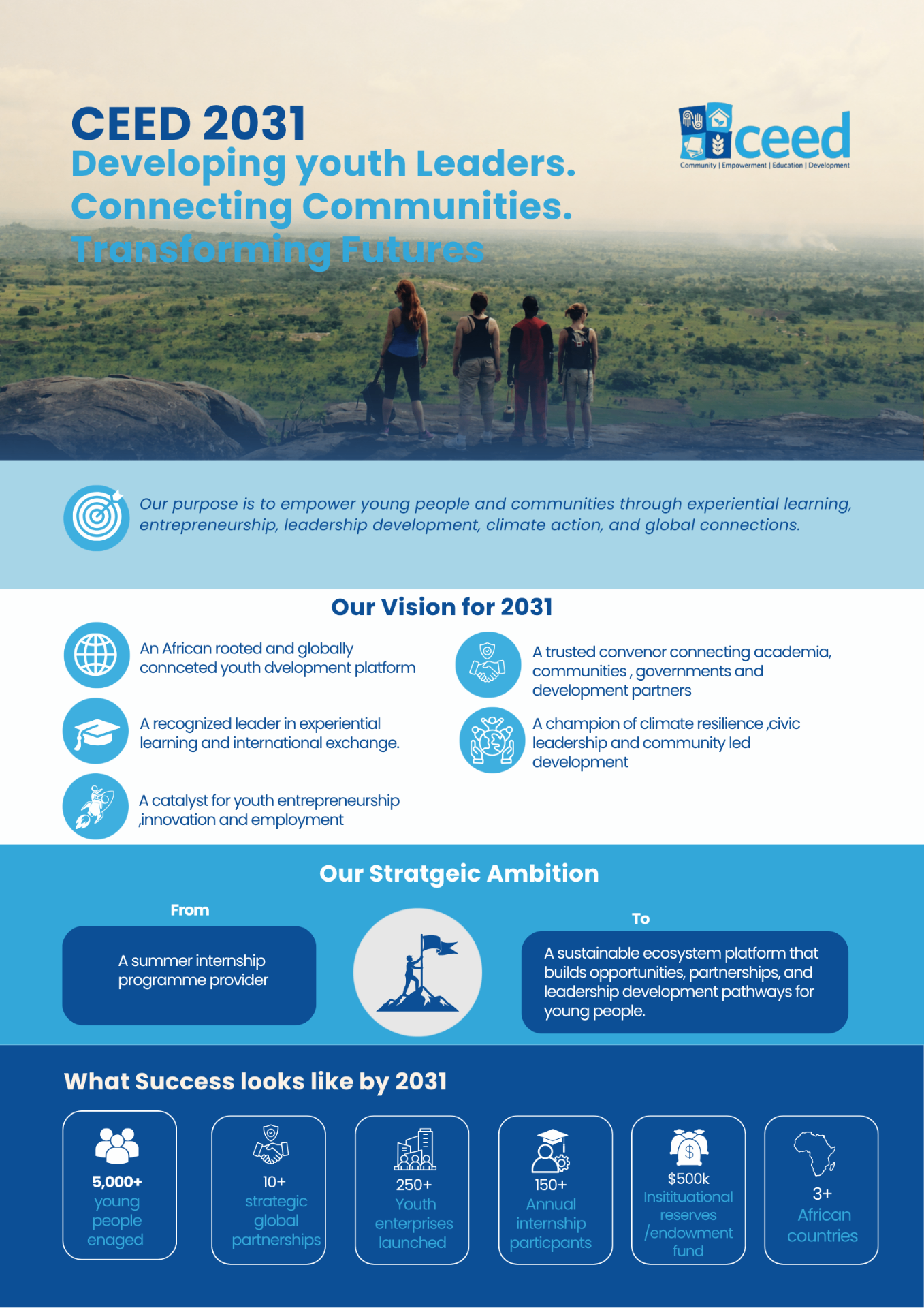
CEED 2031 — Developing Youth Leaders. Connecting Communities. Transforming Futures.
The strategic ambition: from a summer internship programme provider to a sustainable, cross-continental youth development ecosystem.
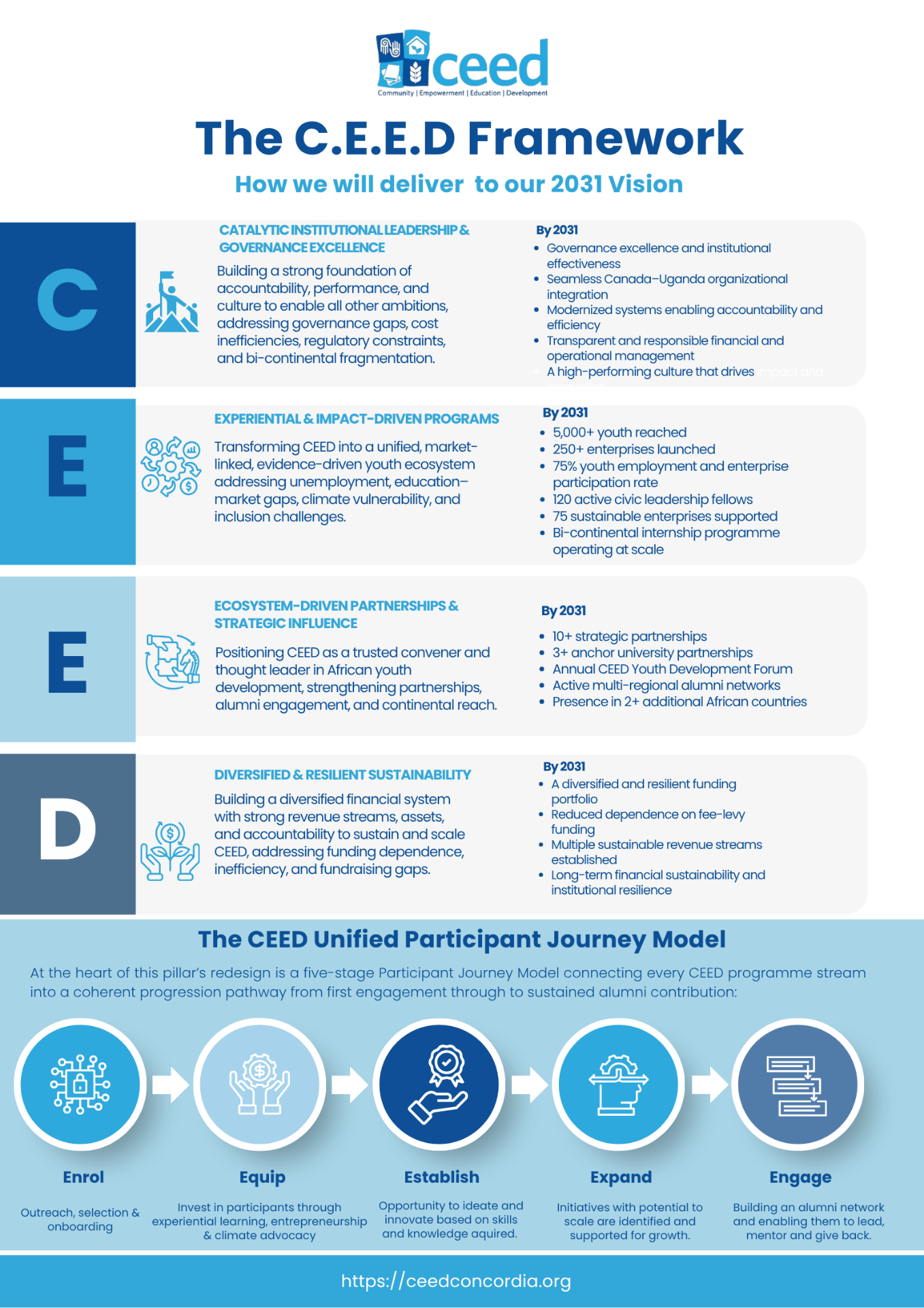
The C.E.E.D Framework — how we will deliver the 2031 Vision.
Four pillars — Catalytic Leadership, Experiential Programs, Ecosystem Partnerships, and Diversified Sustainability — anchored by a five-stage Participant Journey Model.
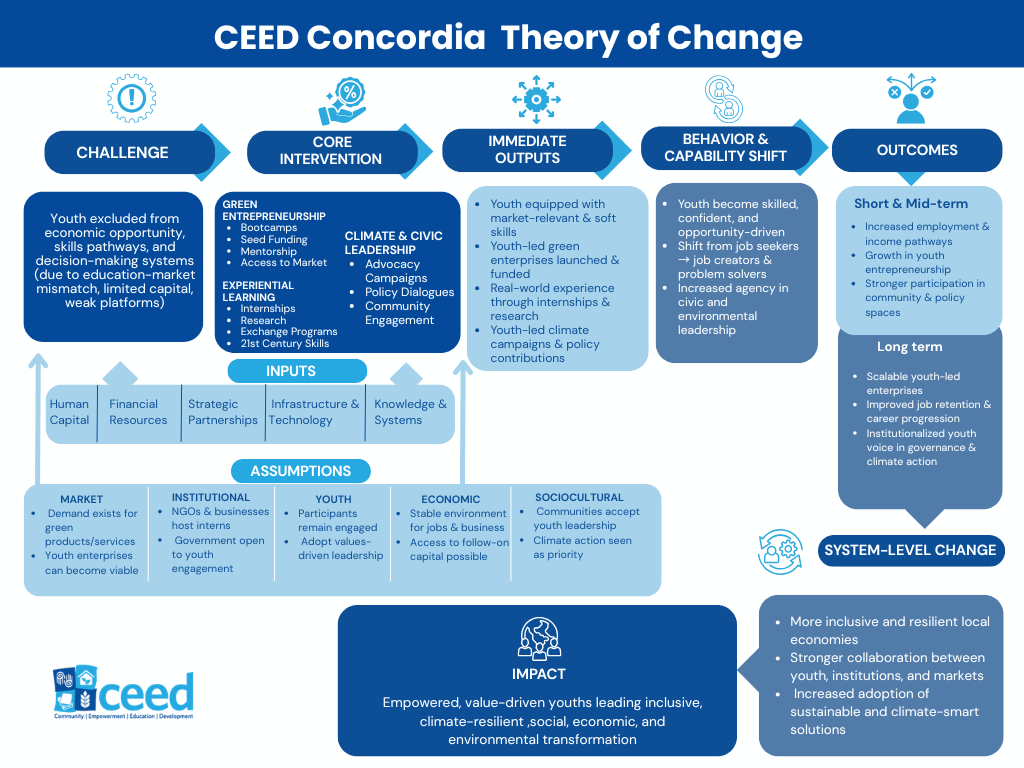
From challenge to system-level change.
Mapping the pathway from core interventions in green entrepreneurship, experiential learning, and civic leadership through to inclusive, climate-resilient transformation.
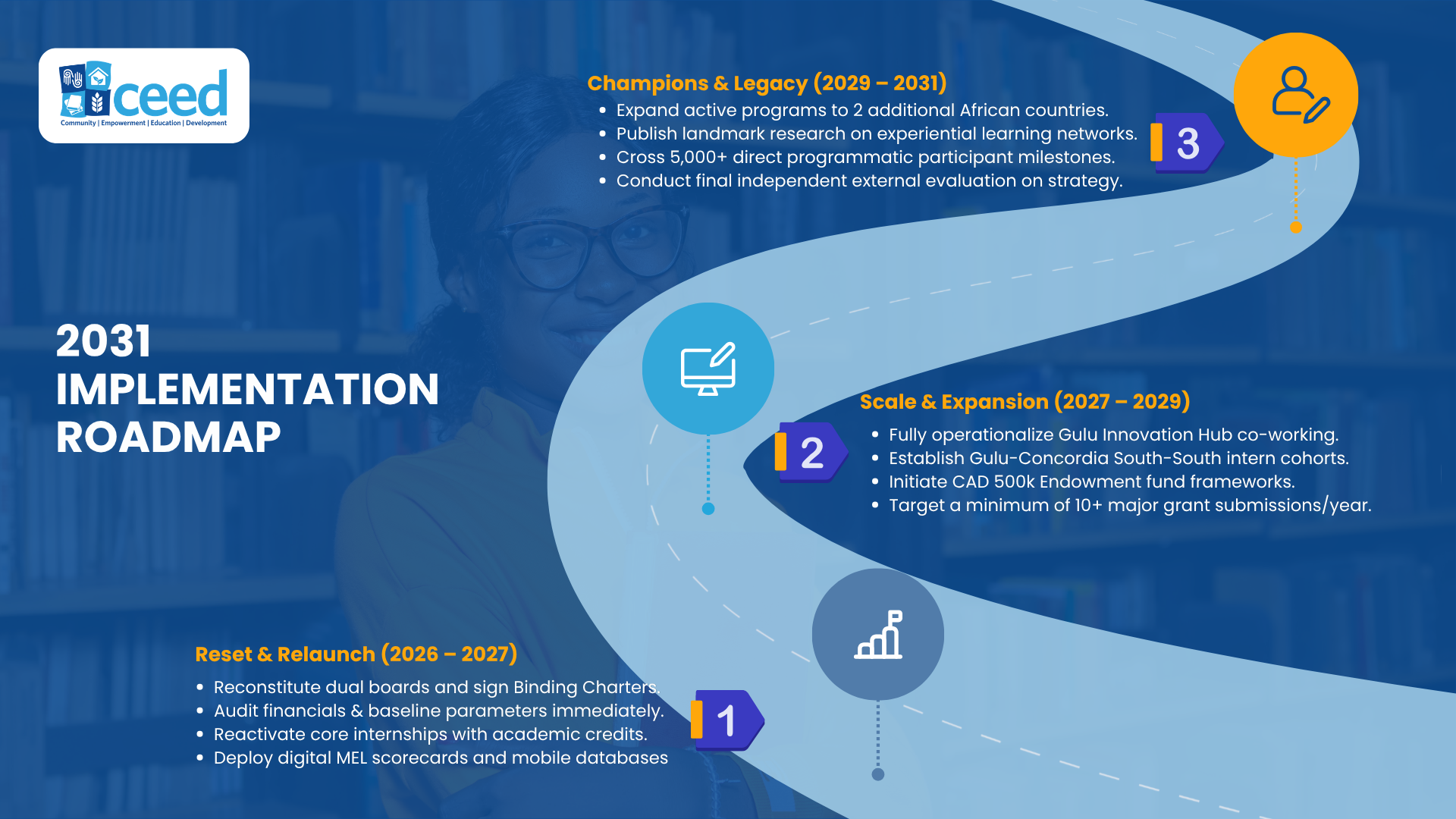
2031 Implementation Roadmap — three phases over six years.
Reset & Relaunch (2026–2027), Scale & Expansion (2027–2029), and Champions & Legacy (2029–2031) — sequenced milestones that turn strategy into delivery.
A clear roadmap for the next five years.
More importantly, the process created alignment — board members, staff and stakeholders could see how their different roles connected to a bigger organizational direction. A stronger foundation for decision-making, fundraising, communication, partnership development, and impact measurement.
A five-year Strategic Plan for 2026–2031
A visual Theory of Change
Strategic priorities, objectives & performance indicators
An implementation roadmap
A communication and stakeholder engagement framework
Recommendations for governance, partnerships and sustainability
The next chapter required more than growth.It required clarity.
By helping the organization move from scattered program activity to a unified strategic framework, Extended Advisory supported a stronger foundation for youth empowerment, community transformation, and cross-continental collaboration — a strategy that honours the organization's legacy while preparing it for a more focused, sustainable, and impactful future.
Extending insight into action